
7 Steps to Curate Kids Craft Supplies Without the Clutter
Last Updated: October 31, 2026
Quick Summary
To curate kids craft supplies, start with a small core library checklist, then sort everything into Keep, Donate, Recycle, or Discard using a 30-minute timer per area. Add specialty materials one at a time only when your child asks, and store everyday items in clear labeled bins within reach.
- The core library covers crayons, markers, paper, safety scissors, glue, clay, pencils, tape, and cardboard tubes.
- Set a 30-minute timer and sort one shelf or bin at a time; three or four sessions clear most playrooms.
- Under 3 get large crayons, chunky chalk, and finger paint only, with no small parts.
- Everyday supplies go low and within reach; specialty and bulk supplies go high and out of sight.
- Swap one ignored bin monthly for a stored bin instead of buying new supplies.
Table of Contents
- Start With a Kids Craft Supplies Checklist
- Sort Everything Into Keep, Donate, Recycle, or Discard
- Choose Safe Art Supplies for Kids by Age
- Match Age-Appropriate Craft Supplies to Each Child
- Learn How to Organize Kids Art Supplies by Type and Access
- Set Up a Rotation and Restock Routine
- Shop the Nexona Mart Craft Supply Edit
- Frequently Asked Questions
Start With a Kids Craft Supplies Checklist
Most playrooms drown in craft clutter because nobody set a limit on the way in.
A curated kids craft supplies collection is a small, deliberate set of materials chosen for your child's age, interests, and available storage space.
Below, we walk through a practical process for organizing craft supplies. The checklist comes first because it prevents the mess before it starts.
The Core Library Every Household Needs
The core library is the everyday set your child reaches for without help. Keep it small, and keep it visible.
- Crayons and washable markers in a few basic colors
- Plain paper, plus one pad of colored paper
- A pack of modeling clay, like our 24 color air dry clay set, which needs no baking and wipes clean
That is enough for drawing, cutting, folding, and building. A child can make a puppet, a collage, or a paper city with this list alone. Everything else is a bonus.

Specialty Materials Worth Adding Later
Specialty supplies are the extras: glitter, paint, beads, foam shapes, and stamp sets. Add them one at a time, and only when your child asks for them.
A common mistake is buying the whole specialty aisle at once.
Wait until your child shows real interest in a new craft. Then add one item and see if it sticks.
Sort Everything Into Keep, Donate, Recycle, or Discard
But a four-box sort only works if you have clear criteria for the tricky items, the half-dried paint, the crayon stubs, the kit your child opened once and abandoned. Here is the decision framework we use.
The Four-Box Method, With Decision Rules
Set up four containers: Keep, Donate, Recycle, and Discard. Then apply these rules in order.
- Keep, anything used in the last month, plus the full core library. If you cannot remember the last time your child reached for it, it does not go in Keep.
- Donate, duplicate sets, unopened kits your child outgrew, and supplies in good condition. Check with local schools, libraries, and community centers first. Only donate items that are complete and clean, a half-used bottle of glue is not a donation, it is a burden.
- Recycle, clean paper, cardboard, and empty plastic containers. Flatten cardboard tubes and boxes to save space. Check your municipal recycling rules for what plastics are accepted locally.
- Discard, dried-out glue, broken crayons, dried paint pots, and anything with a cracked cap. If a crayon cannot make a mark, it is not a craft supply anymore.
Handling the Ambiguous Items
The hard decisions are never the obvious trash, they are the in-between items. Here is how to resolve them quickly:
- Dried-out markers: Test on scrap paper. If the color is faint or scratchy, discard. Do not keep a marker "for backup", you will never use it.
- Broken crayons: If they are still large enough to hold, keep them in a "broken crayons" jar for melted-crayon projects. If they are tiny stubs, discard or save for a crayon-melting craft you will actually do this month.
- Half-used paint pots: Squeeze a small amount onto paper. If it is clumpy or separated, discard. Do not try to revive dried acrylic, it will not mix smoothly.
The 30-Minute Timer
Set a timer for 30 minutes and work in one small area at a time, a single shelf or one bin. The timer keeps the job from turning into an all-day project. When the timer rings, stop. You can repeat tomorrow. Most families find that three or four 30-minute sessions clear an entire playroom.
Sustainable Disposal of Scraps and Unused Materials
Craft clutter has an environmental cost, and the sort is your chance to reduce it. Paper scraps, cardboard, and clean plastic containers go in recycling. But some materials need special handling:
- Dried paint and glue: Scrape out what you can into the trash, then rinse the container for recycling if your local program accepts it. Do not pour liquid paint down the drain.
- Markers: Many communities have marker recycling programs through office-supply stores or school drives. Check before tossing a full bin.
- Glitter: Glitter should go in the trash, not the recycling bin or the sink.
A common pattern is that parents feel guilty discarding craft supplies, so they keep them in a "later" box that never gets opened. The four-box method works because it forces a decision now. If you would not give it to your own child to use today, it does not belong in the curated collection.
Choose Safe Art Supplies for Kids by Age
Safety comes down to three things: choking risk, material safety, and supervision level. A safe art supply is one that matches your child's age and is used with the right amount of adult oversight.
Here is the short version:
- Under 3: large crayons, chunky chalk, and finger paint only. No small parts.
- Ages 3-5: washable markers, glue sticks, safety scissors, and soft clay.
- Ages 6-8: regular scissors, colored pencils, watercolor sets, and simple sewing or weaving.
Check labels for "non-toxic" and "washable." The Art and Creative Materials Institute certifies art materials for safety, and its seal is a good sign to look for on any paint or marker set.
Keep strong glues, spray paints, and craft knives out of reach at all times. These are adult tools, not everyday supplies.
Match materials to your child's age and supervision level with this quick reference.
| Age | Safe supplies | Supervision note |
|---|---|---|
| Under 3 | Large crayons, chunky chalk, finger paint | No small parts |
| Ages 3-5 | Washable markers, glue sticks, safety scissors, soft clay | Age-matched adult oversight |
| Ages 6-8 | Regular scissors, colored pencils, watercolor sets, simple sewing or weaving | Age-matched adult oversight |
| Ages 9+ | Acrylic paint, craft knives, more complex kits | Craft knives with supervision |
| All ages | Look for non-toxic and washable labels | Keep strong glues, spray paints, craft knives out of reach |
Match Age-Appropriate Craft Supplies to Each Child
One bin does not fit every child. A four-year-old and a ten-year-old need very different materials, and mixing them causes both frustration and mess.
For younger children, choose supplies that are easy to grip and hard to break. Chunky crayons, large paper, and simple sticker sheets work well.
Older kids want control and detail. Fine-tipped markers, real scissors, and project kits with instructions suit them better.
100 Pcs Rainbow Scratch Paper Art Notes - Crafts for Kids Ages 4-8, Classroom →
If you are choosing toys and supplies by age and want more detail, our guide to the best educational toys for creative kids breaks down what actually builds skills at each stage. And if you have a tween at home, are craft kits for teens worth it at home answers the question most parents ask before buying.
Learn How to Organize Kids Art Supplies by Type and Access
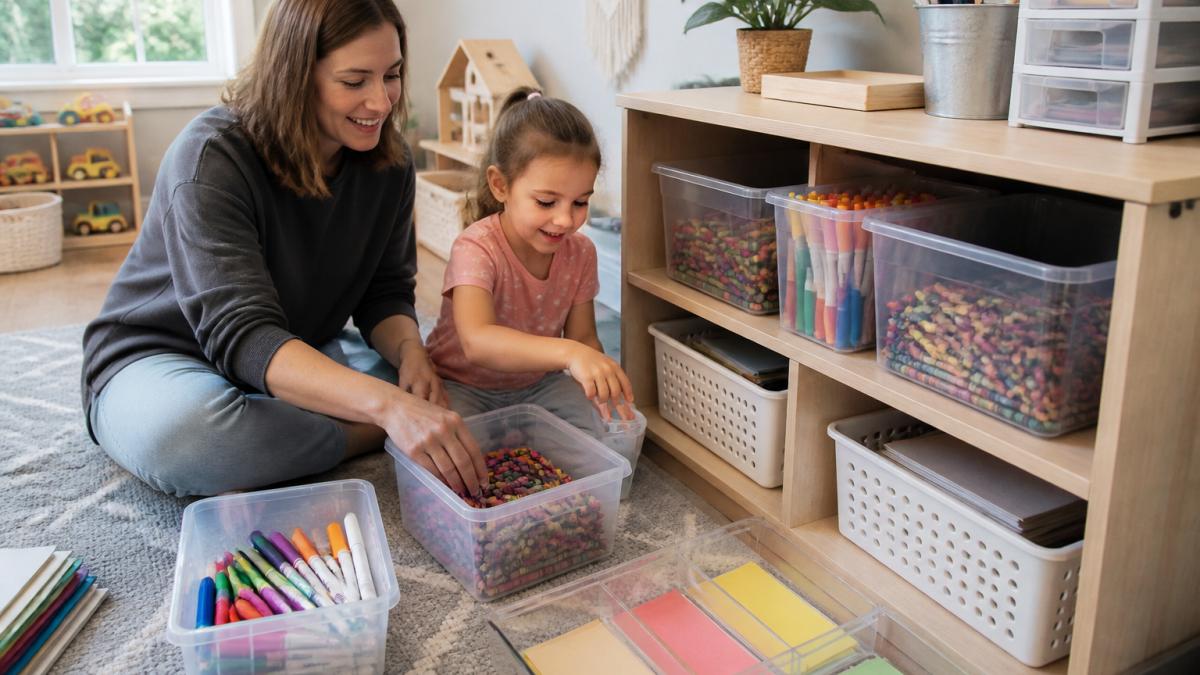
The best storage system groups supplies by type and splits them by who can reach what. Everyday supplies go low and within reach. Specialty and bulk supplies go high and out of sight.
Bins, Trays, and Caddies That Actually Work
Clear plastic bins win because your child can see what is inside. Use shallow bins for crayons and markers, and deeper ones for paper and clay.
A compartmentalized tray keeps small items from mixing.
Label every bin with a word or a simple drawing. Even pre-readers can match a picture of scissors to the right box.
Storing Paper, Coloring Books, and Finished Artwork
Paper is the hardest thing to store because it is flat and floppy. A three-ring binder with plastic sleeves keeps coloring books tidy and stops pages from tearing.
For finished artwork, use a large flat folder or a simple portfolio. Keep only the pieces your child loves. Photograph the rest and let them go.
Zippered pockets inside the binder hold small cut-outs, stickers, and loose scraps.
Set Up a Rotation and Restock Routine
A rotation routine keeps the collection fresh without buying anything new. But a routine only works if it has a mechanism, a way to decide what to rotate, how to track what you have, and how to adapt the system to your space and budget. Here is the full system.
The Weekly Five-Minute Tidy
Once a week, set a five-minute timer. Everyone in the household puts supplies back in their labeled bins. The goal is not deep cleaning, it is preventing the daily drift that turns a tidy shelf into a pile. Keep a small basket for "homeless" items (the stray bead, the cap that lost its marker) and sort it during the monthly check.
The Monthly Rotation
Once a month, pull out one bin your child has ignored and swap it for a stored bin. This is the core of the rotation: you are not buying new supplies, you are reintroducing old ones.
Use a simple inventory card taped to the inside of each stored bin. Write the date it was last rotated and the date it should come back out.
The Seasonal Check
Four times a year, check consumables: glue, paint, markers, and clay. Replace only what is used up. Do not buy ahead unless you have a specific project planned. A common mistake is stocking up on paint in January only to find it dried out by summer.
This is also the time to check safety supplies: replace dull scissors, discard cracked glue sticks, and confirm that adult-only materials (craft knives, strong adhesives, spray paint) are still stored out of reach.
Adapting the Routine to Your Space and Budget
The same system works whether you have a large collection or a small one. Scale the number of bins, not the rules.
- Small homes or shared rooms: Use a single portable caddy for everyday supplies and one under-bed storage box for the backup. Rotate from the box monthly. The caddy lives on a shelf or in a closet and comes out only during craft time.
- Low-budget setups: Clear plastic shoe boxes and shower caddies work as well as specialty organizers. Label with masking tape and a marker. A three-ring binder with plastic sleeves is a low-cost way to store coloring books and finished art.
- Large collections: Use a shelving unit with shallow bins at child height and deep bins up high. Keep a master inventory list on the inside of a cabinet door so you can see what is stored where without digging.
Before Birthdays and Holidays
Do a quick sort two weeks before any gift-giving occasion. New supplies need somewhere to go, and the sort prevents the post-holiday pile-up. Use the four-box method from the sorting section: keep, donate, recycle, discard. If a new kit arrives, decide immediately whether it replaces an old one or goes into storage.
Shop the Nexona Mart Craft Supply Edit
Curating is easier when you start with supplies that are already worth keeping. That is the idea behind our craft edit.
We stock a focused range of craft materials for kids, chosen for quality and easy cleanup. Our acrylic paint marker set is suited to crafts such as rock painting and decorating on various surfaces. Our rainbow scratch paper notes are crafts for kids ages 4-8.


Listings include product descriptions and specifications. Guest checkout is available, and registered users can track orders and save items to a wishlist.
Frequently Asked Questions
How do you choose craft supplies for kids?
Start with a core library: crayons, washable markers, paper, child-safe scissors, glue sticks, and one modeling material. Then add specialty items only when your child shows interest. Check labels for non-toxic wording and age recommendations before buying. Keep the active collection small enough that your child can see and reach everything, and store bulk or refill packs out of reach so supplies last longer and cleanup stays quick.
What craft supplies are safe for young children?
For toddlers and preschoolers, choose large crayons, washable markers, chunky glue sticks, and paper with no small parts. Avoid loose beads, tiny pom-poms, and sharp tools until you can supervise closely. Air dry clay labeled as made without high-concerned chemicals, like the 24-color set from Nexona Mart, is a soft option for young sculptors. Always check the packaging for age guidance and non-toxic claims, and keep hazardous items such as permanent markers on a high shelf.
How often should you rotate children's craft supplies?
A monthly rotation works for most families. Pull out supplies your child has outgrown or ignored for a few weeks, and bring back stored items to feel new again. Do a quick declutter each time: toss dried-out markers, recycle scrap paper, and donate duplicates. This keeps the active collection tidy and makes restocking easier. Pair the rotation with a seasonal restock before school holidays so you are not caught short on paper or glue.
How can I keep kids craft supplies from becoming cluttered?
Give every supply a home. Use clear bins, a compartmentalized tray, and a portable caddy so items go back easily. Keep only everyday supplies within reach and store bulk materials in labeled boxes on a high shelf. Set a five-minute tidy-up at the end of each craft session, and keep a small recycling bag nearby for scraps. A simple rule like one project out at a time stops the table from turning into a pile and makes the next session faster to start.
The hardest part of curating is not the sorting. It is keeping the system going once the novelty wears off. That takes supplies that hold up and a shop you can trust to send what the photos show.
Nexona Mart is built for exactly that: a carefully curated selection, secure payment options including PayPal, and guest checkout when you are in a hurry. Get started with Nexona Mart and build a craft collection your kids can actually use.
