
Durable Pet Toys for Aggressive Chewers: 2026 Guide
Table of Contents
- Why Durable Pet Toys for Aggressive Chewers Need a Different Buying Approach
- How to Choose Dog Toys for Heavy Chewers
- Best Dog Toys for Aggressive Chewers: What Separates a Tough Toy From a Chew-Proof Claim
- Safe Chew Toys for Dogs: Materials, Tooth-Fracture Risk, and Supervised Chewing
- Rubber, TPR, and Natural Rubber: How Chew Resistance and Wear Resistance Actually Work
- Stuffable and Treat-Dispensing Toys for Enrichment and Mental Stimulation
- Cleaning, Hygiene, and Long-Term Value: Replacement Cost and Price
- Conclusion
- Frequently Asked Questions
Last Updated: October 19, 2026
Why Durable Pet Toys for Aggressive Chewers Need a Different Buying Approach
A power chewer can destroy a "tough" toy in minutes, and the wrong pick wastes money and creates a real choking risk. Durable pet toys for aggressive chewers need to be judged on material, size and jaw strength, not marketing labels, The gap between a toy that survives months and one that fails in an afternoon comes down to three things: the material's hardness, the toy's dimensions relative to the dog's mouth, and whether the dog is a crusher or a shredder.

Below, we break down how to match a toy to your dog, what the material names actually mean, and how to know when a toy has reached the end of its life.
How to Choose Dog Toys for Heavy Chewers
Choosing for a heavy chewer means matching three variables at once: jaw strength, chewing style, and toy size. Get one wrong and even a well-made toy fails early.
Match the Toy to Jaw Strength and Chewing Style
Dogs chew in broadly different ways. Some crush and compress a toy in the back of the mouth; others scrape and shred with the front teeth.
A common mistake is buying by breed size alone: a medium dog with a strong jaw can out-chew a large breed with a gentler mouth. Watch how your dog works an existing toy for a few days, then buy to that behaviour rather than the packaging label.
Size, Weight Range, and Toy Dimensions
Size is a safety issue, not a cosmetic one: a toy small enough to fit fully behind the dog's back teeth can be swallowed.
- Small dogs: lighter, smaller toys, but still firm enough to resist puncturing
- Medium dogs: the widest range of options; check wall thickness
- Large and giant breeds: oversized toys with thick walls and no small end caps
For reference, a compact chew toy in the Nexona Mart pet range weighs around 40g and is built for puppy and small-to-medium chewing. If a listing does not state weight and dimensions, ask before you buy.
Best Dog Toys for Aggressive Chewers: What Separates a Tough Toy From a Chew-Proof Claim
The best dog toys for aggressive chewers share four traits: a solid, thick-walled body, a material with some elasticity, no weak seams, and a size that suits the dog. Everything else is marketing.
Here is how to tell a genuinely tough toy from a hopeful label:
| What to check | Sign of a tough toy | Warning sign |
|---|---|---|
| Material | Natural rubber or firm TPR, stated clearly | Vague "premium material" with no name |
| Wall thickness | Thick, solid sections | Thin hollow shell |
| Seams and joins | Smooth, moulded one-piece body | Visible glued seams or small caps |
| Size | Clearly larger than the dog's mouth | Fits fully behind the back teeth |
| Surface | Gentle ridges for grip and gum contact | Sharp edges or hard moulded points |
| Labelling | Honest durability language | "Indestructible" with no caveats |
A toy that passes all six is a reasonable bet for a heavy chewer under supervision. A toy that fails two or more is a chew-toy gamble.
Safe Chew Toys for Dogs: Materials, Tooth-Fracture Risk, and Supervised Chewing
Safe chew toys for dogs balance durability against hardness, because the hardest toys are often the ones that damage teeth.
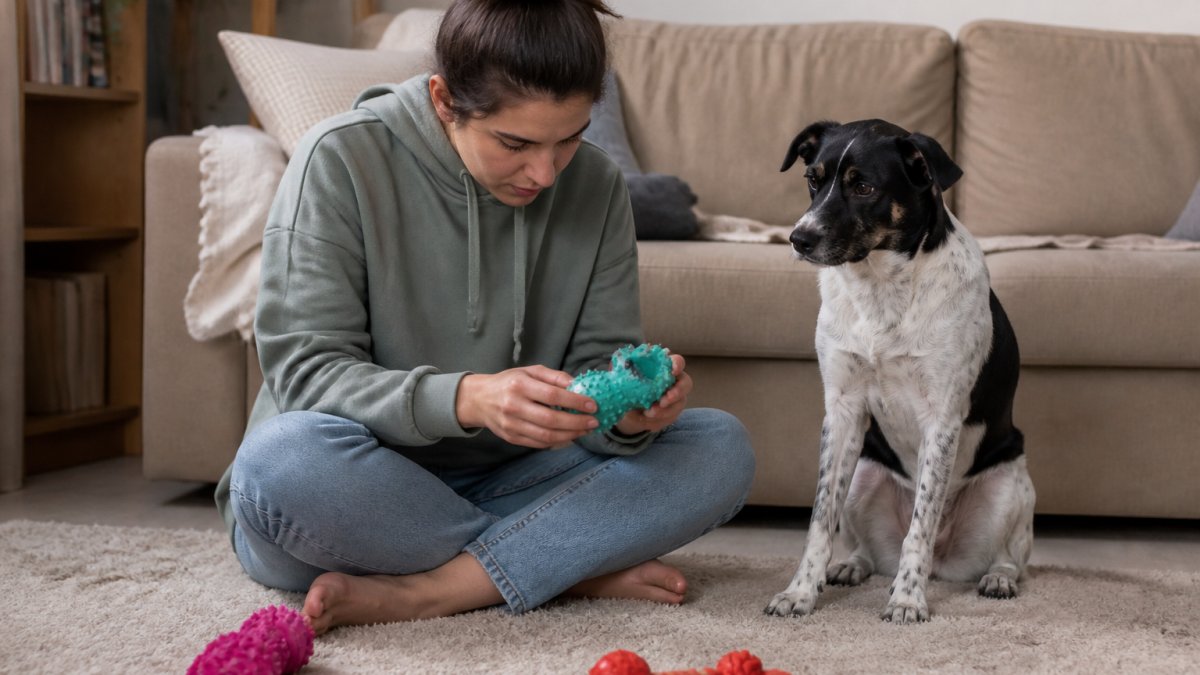
Supervised chewing matters as much as material choice. Give a new toy for short sessions, watch how the dog works it, then remove it, that habit catches failures before a chewed edge becomes a swallowed piece.
When to Replace a Toy: Cracks, Wear, and Choking Hazards
Replace a chew toy as soon as you see cracks, deep gouges, missing chunks, exposed inner material, or a loosened end. A worn toy is not broken in; it is weaker. Check every toy weekly by flexing it and running a thumb along the edges.
Rubber, TPR, and Natural Rubber: How Chew Resistance and Wear Resistance Actually Work
Chew resistance and wear resistance are different properties, and confusing them is why buyers end up disappointed. Chew resistance is how well a material survives compression and puncturing from the back teeth. Wear resistance is how well it handles scraping and abrasion from the front teeth over time. A toy can be excellent at one and poor at the other, which is why a single "durability" star rating tells you almost nothing.
What the Material Names Actually Mean
Natural rubber is harvested from latex and vulcanized into elastic solids. In chew toys it is valued for rebound: it flexes under jaw pressure and returns to shape rather than cracking. Its weakness is abrasion, a determined front-tooth scraper can wear a groove into it over weeks.
Neither natural rubber nor TPR is automatically better. Wall thickness, shape, and the absence of thin seams matter more than the material name on the package.
A Simple Home Test for Chew Strength and Durability
Because no standardized consumer test exists, approximate one at home to compare claims across products:
- Thumb-pressure test. Press a thumbnail firmly into the toy's thickest wall. A good chew toy flexes slightly and rebounds. Rock-hard with zero give means a tooth-fracture risk for a strong chewer; a permanent dent means it is too soft for a power chewer.
- Flex-and-twist test. Bend the toy and twist it gently. Listen and look for hairline cracks at seams or stress points. A toy that cracks before your dog touches it will fail faster under real chewing.
- Seam inspection. Run a finger along every join. Molded one-piece bodies are safer than glued seams or press-fit caps, which are the first things a shredder will exploit.
- Supervised wear trial. Give the toy for short, watched sessions over the first week. Note where the first gouges appear, edges, ends, or ridges, because that tells you how your dog attacks toys and which features to avoid next time.
- Log the failure date. Record when each toy shows its first crack or missing chunk. After two or three toys, you have a personalized durability benchmark that is more reliable than any manufacturer claim.
Matching Hardness to Your Dog, Not Just the Label
A toy's suitability depends on jaw strength, chewing style, age, and tooth condition, not breed or weight alone. A senior dog with worn enamel needs a softer toy than a two-year-old power chewer of the same size, and a puppy still losing teeth needs more give than an adult. Use the thumb-pressure test: the toy should resist puncturing but still flex under firm pressure.
Stuffable and Treat-Dispensing Toys for Enrichment and Mental Stimulation
Stuffable and treat-dispensing toys extend chewing time and add mental stimulation, which matters most for dogs left alone. A hollow toy filled with food keeps a dog occupied, reduces boredom-driven destruction of furniture and shoes, and turns one chew session into a longer, calmer activity. For aggressive chewers, that enrichment only holds if the toy survives the dog's chewing style, and if you clean it properly between fillings.
How Stuffable Toys Actually Work for Power Chewers
The mechanism is simple: food packed into a hollow chamber forces the dog to lick, nibble, and work the toy rather than gulp. Freezing a stuffed toy slows the dog further and extends the session, especially useful for dogs that finish a room-temperature filling in minutes. The key safety rule: the toy must still be sized for the dog when empty, because once the food is gone the dog keeps working on the toy itself.
Cleaning and Hygiene: A Protocol, Not an Afterthought
Trapped food residue is a hygiene issue and a breeding ground for bacteria. Most rubber and TPR stuffable toys are washable, but the routine matters more than the material:
- After every filling: rinse the toy thoroughly with warm water and a mild, pet-safe soap. Use a bottle brush or small scrub brush to reach inside the chamber, where residue collects.
- Weekly deep clean: soak the toy in warm soapy water for several minutes, scrub all interior surfaces, and rinse until the water runs clear.
- After every wash: inspect the toy for cracks, gouges, and loose pieces before refilling. Washing is the natural moment to catch wear you might otherwise miss.
Alternatives for Dogs That Destroy Stuffable Toys
Some dogs treat a stuffable toy as a puzzle to solve and then a shell to destroy. If your dog consistently chews through the walls of stuffable toys, safer alternatives include:
- Supervised-only use: give the stuffed toy for short, watched sessions and remove it when the food is gone, before the dog turns on the toy itself.
- Lick mats and puzzle feeders: these redirect the dog's tongue and brain without presenting a chewable shell, and they are easier to inspect for wear.
- Larger, thicker-walled hollow toys: size up and choose toys with solid, molded one-piece bodies rather than thin shells with caps.
A dog with a satisfying, refillable toy is less likely to redecorate your sofa, provided the toy is sized correctly, cleaned regularly, and checked after every session.
Cleaning, Hygiene, and Long-Term Value: Replacement Cost and Price
Long-term value comes from cost per month of safe use, not sticker price.
Cleaning is part of that value calculation. Most rubber and TPR chew toys are washable and reusable, so a quick wash with warm water and mild soap keeps them hygienic and extends useful life.
- Wash stuffable and treat toys after each filling
- Inspect weekly for cracks, gouges and loose pieces
- Retire any toy that fails the flex-and-thumb test
When comparing prices, divide the cost by the months of use you realistically expect. That number, not the shelf price, tells you which toy is the better buy.
Owners of power chewers who want one refillable toy that doubles as enrichment, provided the toy is sized correctly and checked after every session.
Conclusion
Finding durable pet toys for aggressive chewers is a matching exercise, not a shopping spree: the right material, the right size, and a realistic view of how your dog chews will outperform any "indestructible" claim.
Nexona Mart curates pet essentials with detailed product descriptions and specifications, so you can check weight, material and size before you buy. Secure payment options including PayPal, guest checkout, and order tracking through an account make the process straightforward.
Frequently Asked Questions
Are any dog toys truly indestructible?
No toy is genuinely indestructible, and any brand claiming otherwise should be treated with caution. Even tough rubber and TPR toys wear down with repeated chewing, and the wear accelerates once cracks or grooves appear. The practical approach is to treat durability as a spectrum: pick a toy rated for your dog's jaw strength, check it after every session, and retire it at the first sign of damage. A toy that survives months of use is a good result, not a guarantee.
What materials are best for aggressive chewers?
Dense rubber and TPR are the most common choices for power chewers because they combine chew resistance with enough elasticity to flex under jaw pressure. Natural rubber is similar but varies more between products, so check the listing. Avoid very hard plastics and anything that feels rigid in your hand, since those raise tooth-fracture risk. Whatever the material, confirm the toy is sized above your dog's throat and supervise chewing until you know how your dog treats it.
How do I choose the right chew toy for my dog's size and chewing style?
Start with weight range and jaw strength rather than breed labels. A 30 kg dog that chews steadily needs a different toy from a 30 kg dog that destroys everything in minutes. Watch how your dog chews: gulpers need larger toys with no small ends, and methodical chewers can handle more complex shapes. Then check the product size against your dog's mouth, and size up if the toy looks like it could be swallowed.
How often should I replace a dog toy that has been chewed?
Inspect the toy after every chewing session and replace it as soon as you see cracks, deep grooves, missing chunks, or a loosened plug or treat opening. For heavy chewers, that can mean weeks rather than months. Toys that pass inspection can stay in rotation, but rotate them so no single toy takes constant abuse. Cleaning also matters: wash rubber and TPR toys regularly to limit bacteria buildup, and dry them fully before the next use.